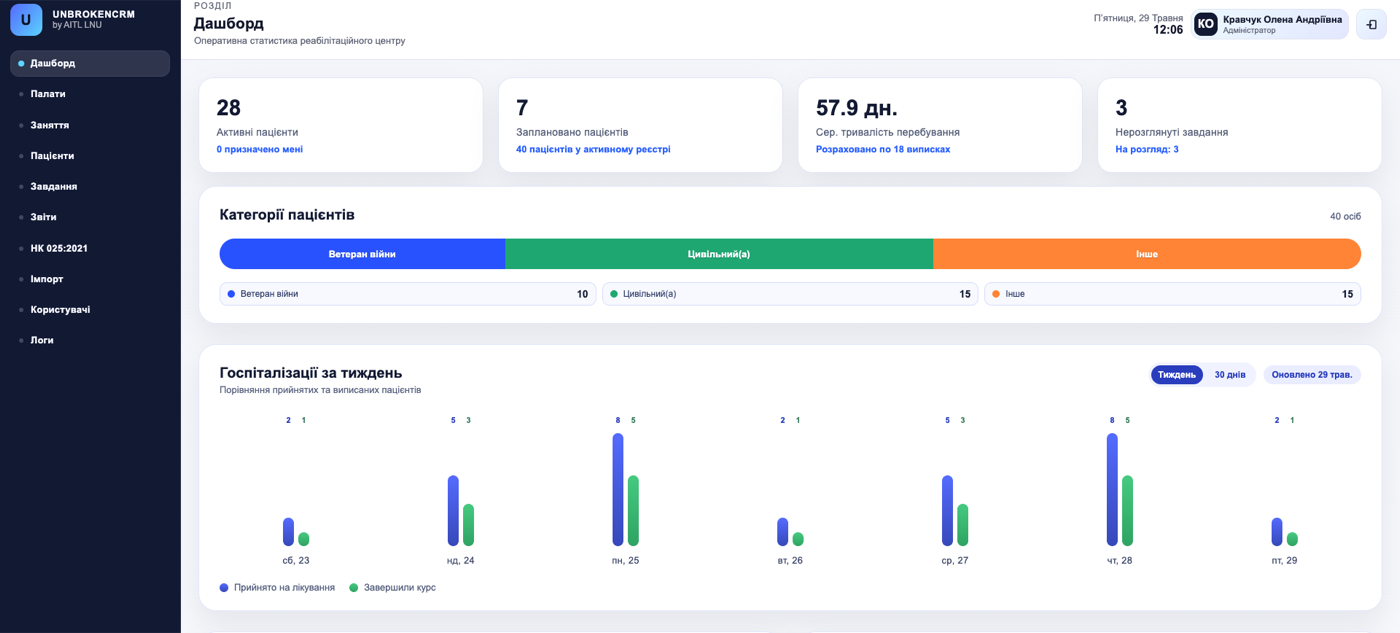
Key modules
A CRM should be designed modularly so it can be launched step by step.
- users and roles
- client or patient cards
- tasks and messages
- calendars and events
- reports and documents
- logs and audit
A CRM should be more than a contact database. For complex organizations it is an operating system: roles, tasks, change history, documents, statuses, team workload and accountability.
The laboratory treats CRM not as a universal template, but as a model of a specific organization. For a hospital it means patients, wards, doctors, tasks and reports. For an education program it means participants, teams, mentors, progress and communication.
This approach makes it possible to build a system where every action has an owner, every field has a reason and data can be used for analytics.
A CRM should be designed modularly so it can be launched step by step.
A serious CRM needs more than “admin” and “user” roles. It requires precise permissions for viewing, creating, editing, exporting and administration.
AI can work on top of CRM: helping with search, record classification, report preparation, workload analysis and anomaly detection in workflows.
Yes, but healthcare scenarios require special attention to access, logging, data protection, staff roles and information-use rules.
A custom CRM is useful when the process is non-standard and specific permissions, integrations, reports or a data model are hard to fit into an existing product.
Yes, but before migration fields must be cleaned, directories aligned, duplicates removed and historically important data identified.
The laboratory is ready to discuss research, prototypes and non-commercial projects with universities, laboratories, companies, hospitals and public institutions.